
CIRCLING
Joint circling is an amazing recuperative technique form that speeds recovery and prevents injury. For 25 years, I have taught this type of movement to my thousands of senior students. I actually first learned of it 50 years ago from Doris Breyer, an insightful movement therapist I was lucky enough to study with. With GRACE development, circling has become an even more indispensable method to bring health and vitality to joints no matter their condition.
Basic circling technique:
For circling to be effective, a sense of release must be included. Here are some recommendations:
- Hold one part of your body firmly. Let the other part move freely.
- Let the passive body part hang like a dead weight.
- Gently swing the passive part back and forth.
- Then circle gently.
- Make the circles small and relaxed. The smaller the better.
- Focus on the complete release of the joint.
- If your joint is tense, warm that part of your body up first and then come back to circling. Repeat the process as needed.
- When moving your lower leg, do not let your foot move. Let the entire leg relax. Let the foot hang.
After releasing the joint,
it works well to stretch the muscles surrounding it.
it works well to stretch the muscles surrounding it.
Particularly effective joints to circle:
- Knees: Holding the thigh immobile and letting the leg and foot dangle and circle is one of the most effective exercises of all time. A valuable recuperative exercise for a vulnerable joint.
- Shoulders: Circling the shoulder is an excellent exercise if you have any rotator cuff strain. It also helps to release stress.
- Fingers and toes: Circling at the base of the digits is wonderful for arthritis. Twiddling your thumbs is a fantastic exercise for the sensitive joints at the base of the thumb.
- Hips: Several moves circle the hips in different ways. All are beneficial, especially in reducing nearby lower back stress.
- Spine: Belly dance technique teaches a number of ways to circle the spine. Very beneficial but keep stress out of the movements when doing them for recuperation purposes.
- The most crucial joint: The joint between the skull and the first vertebrae of the spine. Releasing tension here is the key to GRACE technique. Several circling movements are not only helpful but quite wonderful in their own right.
The best joint to start with: The shoulder.
- Stand near a sturdy table like a dining room table.
- Lean over the table, rest your weight over one arm, braced against the table, with your other arm hanging straight down.
- Maneuver it so that the hanging arm can swing freely in all directions.
- Gently swing the arm back and forth.
- Gently allow it to circle. Circle in both directions.
- Completely release the shoulder joint.
- Finnish by rotating the hanging arm so that the palm faces forward and then back.
Circling has an amazing property:
As the muscles around one joint release through circling, the nervous system signals to adjacent joints that they too can release. As they release, the rest of the body does in turn. This is especially effective when it involves the spine. As you will see, there are several circling exercises which generate deep sequential spinal release, all due to the stimulation of the most crucial joint in the body.
The most crucial joint in the body:
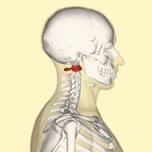
The red object to the left is the atlas vertebrae. It is the first vertebrae in the spine. The area directly above it is the C1 joint connecting the skull to the spine. It is in effect the first joint of the spine. It has special properties. For instance, it is the only spine joint which can circle independently of the others. That gives it a particular significance, especially for GRACE technique.
Ways to circle the most crucial joint:
I have found 2 effective ways to isolate the C1 joint (the atlanto-occipital section where the skull meets the atlas vertebrae).
- Seated or standing, hold the skull and lift upwards and then circle. Hold your head with both hands, thumbs under the chin and fingers at the back of the head. Think of your hands as a saucer and your head as a bowling ball. Circle only the bowling ball in both directions.
- Standing, leaning over, place both hands on the ground. Soften the knees and allow the head and torso to be heavy. Totally relax the spine. Allow the head only to gently circle in each direction. I experience 2 results from this: Often my spine will "crack" as it adjusts to its correct alignment. I also feel a sequential release ripple through the spine as a result of circling only that first joint.
Belly dance circling:
The smooth isolations of belly dance can be so beneficial for our entire body but especially for the spine. This not only includes circling but also all the figure 8s. When you circle your hips, for instance, using "umis" (also known as interior hip circles), even if you hold your rib cage still, all the spine joints below it circle. Also, the joints of the knees and ankles circle. Take a moment and feel what I am talking about. Chest circles obviously circle the joints of the rib cage and if done correctly, don't affect the joints of the pelvis or the neck. But all the thoracic joints circle, each slightly differently. All these marvelous smooth isolations circle joints in groups to varying degrees. Only the C1 joint can circle independently. Circling C1 using a belly dance style head isolation while suspending from the nape of the neck would be a powerful focus to try.
The nature of joints:
A joint is defined as where 2 bones come together. Cartilage separates the bones from touching while protecting them.
There are approximately 360 joints in the human body. They are of 3 types: All but the fibrous joints benefit from circular movement.
- Synovial (moveable) joints: 100-200 freely moving joints like the knees, shoulders and hips.
- Cartilaginous (slightly moveable) joints: 80 limited movements joint which are connected by cartilage. The joints of the spine are a good example.
- Fibrous (immovable) joints: 80 joints bound by dense connective tissue which don't move. The adult skull for instance.
There are several different ways you can move your joints:
- Hinge action is the most common and the most stressful. Straightening and bending your knees, for example, is so common we don't think about it. When we have an injury or vulnerability in that area, we frequently indulge in hinge motion when this really should be the last type of movement performed for a joint under stress, not the first.
- Lateral movement: The spine is a good example of this.
- Rotation: Rotation is twisting, not circling. Once again, the spine is a good example.
- Circumduction (aka circling): This is usually accomplished when one body part is stationary as the other is circling.
Some interesting details:
- The spine moves in all ways possible though the range of motion is very limited and the joints move as a unit instead of individually. The spine straightens and bends, twists, moves sideways and is capable of circling.
- The hips do everything. They are the strongest joints in the body and also potentially have a huge range of motion as do the shoulders.
- The knees and elbows straighten and bend and circle. They cannot move laterally (any soccer mom will tell you that).
- The fingers and toes: The joints of the fingers and toes straighten and bend, have very limited rotation and circling capacity and no lateral movement. Except for the base joints: the knuckles for the hands and the ball of the foot for the toes. Circling, gently twisting and pulling your fingers and toes are an excellent way to improve hand/foot health.
- Some joints thought of as single joints are actually quite complex. The ankles have 10 joints, not one. So do the wrists. When they move in any direction, they move as a group.
For more information on the specifics of how to circle your joints:
Published July 4, 2026.