
BUILDING BETTER BALANCE FOR DANCERS
I once saw a San Francisco Ballet prima ballerina wobble and fall off her point. An instant ruined a ballet. Balance is like that. If you are off balance in performance it can be more than embarrassing. This article describes exercises designed for dancers which improve balance. They are really helpful whether you are a dancer or not.
We are two legged creatures. Many mammals have four. Watch a horse galloping or a cat leaping and you see beautiful balance in action. That same kind of grace does not come naturally to a human being and it's all because we stand on two feet. Our balance is far more delicate, complex and easily thrown off. We have to use major core strength to remain upright compared to four legged animals. In effect we have to sandwich together a number of different allies to maintain our balance.
Balance itself is a complex sense made up of other senses:
- The inner ear sends information to the brain about the location of the head in space.
- The eyes inform the brain about the dimensions of the real world. Focusing the eyes stabilizes balance immediately.
- Proprioception: The feet and hands signal to the brain where the limbs are in space. The feet in particular provide critical information that helps us keep balanced. Without it, the brain is blind. This is one reason those with peripheral neuropathy are so much more at risk of falling.
Balance requires awareness and mental focus.
What improves balance?
- Practice foot exercises: Increase the strength and agility of your foot and ankle joints. The exercises can be seated and/or standing. Practice good alignment from the foot bed through the ankle. Increase the agility of the MTP joints at the base of the toes.
- Engage your core: This will always stabilize your balance.
- Focus your eyes: Look at something immediately in front of you and focus on it. Make certain the object is not moving. Do not focus on people. Eye focus immediately improves balance. Dancers use this all the time when spotting turns.
- Soften your knees: Locked knee joints are not only bad for your body but they also throw your balance off. To regain balance, get closer to the earth and simply soften your knees.
- Improve your sense of proprioception: Any sense can be improved with practice. Proprioception is no exception. Practicing feeling the placement of your feet will improve this sense. And that improvement can powerfully effect your dance ability.
Ankles play a special role in balance: From both a strength and an agility point of view. Because we are two legged, our ankles have to essentially serve as adjustable joints which buffer our body's connection to the ground. The ankle has seven bones and ten joints, all of them moveable. They are in constant motion as the body makes minute modifications to maintain balance. The stronger the ankles the better the balance.
Anatomy of the foot:
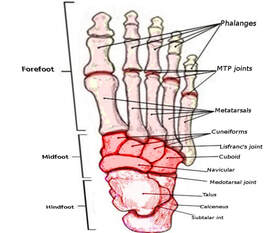
To the left is an image of the bones and joints of the foot. The longest bones are the metatarsals. The joint that connects them to the toes (phlanges) are the MTP joints or the joints at the base of the toes. These are the joints that allow us to stand on the ball of the foot. Often they are stiff. The higher the angle of the MTP joint, the better.
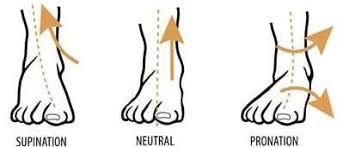
Alignment: Balance is really based upon the alignment of the foot, ankle and leg bones as well as the proper placement of weight on the foot itself. Often the ankle alignment is off as shown in the first diagram below. This affects all other balance issues as the body attempts to adjust. Practice correct alignment and your balance will improve exponentially.
Regarding the diagram on the left: Pronation, shown on the right, seems to be quite common in belly dance. Strive to keep the alignment neutral. Strengthen the foot and ankle. Using elastic stretch bands, you can fortify the ankle effectively in any needed direction. Strengthening the inside arch of the foot is another good idea.
On the right are the proper alignment lines for the bottom of the foot. The 3 dot triangle is how you should think of your weight being distributed over your foot. The central line is the line you should use to keep your foot and lower leg in alignment when bending them.
Regarding the diagram on the left: Pronation, shown on the right, seems to be quite common in belly dance. Strive to keep the alignment neutral. Strengthen the foot and ankle. Using elastic stretch bands, you can fortify the ankle effectively in any needed direction. Strengthening the inside arch of the foot is another good idea.
On the right are the proper alignment lines for the bottom of the foot. The 3 dot triangle is how you should think of your weight being distributed over your foot. The central line is the line you should use to keep your foot and lower leg in alignment when bending them.

Much more is available regarding this subject in the article "Essential Alignments", another Building Better Balance feature.
Types of Balance:
- Static balance: Balance in stillness. Single leg balances are a good example. Ballet barre exercises are another.
- Dynamic balance: Balance in movement. Balance as you shift your weight from one foot to the other.
- Parallel versus turned-out: Yoga is based on the feet being in parallel. Ballet is based on turned-out. Belly dance uses a combination. Isolations in particular must be done in parallel.
Static Balance:
The type of balance which we need for dance is really dynamic balance. Rarely for example, do you stand on one foot in a choreography for more than a moment. But, the most common way to improve balance is to practice static techniques. Yoga and ballet use static exercise extensively. Both have methods helpful for any dancer.
Ballet: There is nothing like ballet to train the feet. I highly recommend practicing simple ballet exercises, especially for the effectiveness of ankle strengthening and foot articulation. However, notice if ballet tightens your hips and lower back. If so, take precautions. Here are some basic examples of ballet drills:
The importance of releve: The MTP joints are the metatarsophalangeals. (The metatarsals are the long bones of the foot. The phalanges are the toes.) These are the joints on the ball of the foot. Ideally the toes will bend back 90 degrees to form a solid base upon which to stand. That is releve. Balance in releve takes a special place in dance. For one thing, it often looks stunning. It can add depth of expression to a choreography. The releve position also allows for a larger range of motion in the hip. In other words you can lift your leg higher in releve. Regardless, practicing holding releve is an excellent thing to add to your daily routine.
Foot articulation: This means being able to express movement throughout the entire foot, using it as the icing on full body engagement. Foot articulation is one of the primary results of ballet training. An increase in engagement is always good for balance.
- Practice going into the 5 ballet positions for the arms and feet.
- In each position, plie and releve 4 times.
- There are many ballet barre exercises which can be found on the Internet which are marvelous to practice.
The importance of releve: The MTP joints are the metatarsophalangeals. (The metatarsals are the long bones of the foot. The phalanges are the toes.) These are the joints on the ball of the foot. Ideally the toes will bend back 90 degrees to form a solid base upon which to stand. That is releve. Balance in releve takes a special place in dance. For one thing, it often looks stunning. It can add depth of expression to a choreography. The releve position also allows for a larger range of motion in the hip. In other words you can lift your leg higher in releve. Regardless, practicing holding releve is an excellent thing to add to your daily routine.
Foot articulation: This means being able to express movement throughout the entire foot, using it as the icing on full body engagement. Foot articulation is one of the primary results of ballet training. An increase in engagement is always good for balance.
Yoga: This oriental physical practice is wonderful for improving balance, in particular the single foot balances. Most positions are performed with the feet in parallel.
Single foot balance practice: This is one of the most important techniques for improving balance. It strengthens your feet while conditioning your core to react to the requirements of one sided support. It is a great place to practice noticing all the tiny adjustments the body makes to balance on one foot.
- Always practice balance by placing your hands on something secure like the back of a chair.
- Use a parallel stance with your feet hip distance apart.
- Instead of going right into a single foot balance, stage it. Start with one foot flat and the other on the ball. Graduate to having that other foot on the top of the toes. Finally stand on one foot.
- You can also stage your hands: Start with both hands resting on the back of a chair. Graduate to one hand, one finger and finally no hands. It is much more effective to use assistance to get strong than to try without it and be unstable.
- Concentrate on the three balance points for your weight on your standing foot and spread it equally on all three.
- Engage the lifted leg. There is a tendency to think of the lifted leg as unimportant. Engaging it solidifies your balance.
- If your lifted leg is drooping, raise that hip slightly.
- Use every trick in the book to maintain your balance. Especially engage the core. Correct your posture. Think of stretching the spine upward. Use visualization.
- There are many different positions you can practice. The standing yoga positions like The Tree and The Dancer are wonderful. But you can add your own. Fred Astaire's favorite was holding the opposite foot while standing on one leg.
Balance in Movement (aka, Dynamic Balance):
Weight shifting: The essence of balance in movement occurs when we shift our weight from one foot to the other. This is actually a revolutionary motion because we go from having our weight completely balanced on one foot to a continuation gap to having our weight completely balanced on the other foot. The brain is very busy recalibrating balance each step. The gap is an integral part. It is where we depend on our core to carry us through.
As always, the core plays a central role: The smooth transition of weight shift is ensured through use of the core, and only the core. The core is also what keeps us safe. Pelvic stability and strength are particularly impactful on both balance and protection from injury.
Adjustments: Each time we land on one leg there is the potential to make adjustments to place our body in balance. The ankle and the knee joints often take on this role. This ability to adapt is a crucial balance skill and one that should be worked on directly. One way to do this is to include deliberate destabilizing movement in single foot balance drills to develop adaption ability.
Focusing on balance in combinations: While practicing choreography or simple combinations, concentrate on being grounded as you move.
What throws our balance off?
- Feeling strong emotions: There is nothing more destabilizing than being emotionally upset. Anyone practicing daily yoga knows that. Some days your balance is awful. Often it's when something is disturbing you. Those are times to simply take extra balance precautions.
- Tension in our knees: Locking the knees ensures that your balance will be off. It is a bad habit to train yourself out of. Keep your knees soft, with your legs straight yet your knee joints relaxed. The knees need to be able to act as shock absorbers and adjustment buffers. When your balance is off, check your knees. Keep them relaxed and flexible.
- Distractions: In our distraction ridden society, it is sometimes hard to maintain mental focus. Yet mental focus is required for many of life's pursuits, especially balance. Our balance is particularly affected directly by visual distractions since eye focus is such an important balance element.
Published February 1, 2026.